OpenAI, the guardian behind the notorious AI chatbot ChatGPT, has introduced the discharge of a brand new multimodal AI, GPT-4. Multimodal, since it may possibly take each photographs and textual content as inputs to provide a text-based output. Based on OpenAI, GPT-4 is “much less succesful than people in lots of real-world eventualities”, although on the identical time, can exhbit “human-level efficiency on varied skilled and educational benchmarks”.
When it comes to availability, GPT-4 is being obtainable to OpenAI’s paying clients, by means of ChatGPT Plus. Builders can enroll on a waitlist to entry the API. Pricing is $0.03 per 1,000 “immediate” tokens (about 750 phrases) and $0.06 per 1,000 “completion” tokens (once more, about 750 phrases). Moreover, OpenAI can also be open-sourcing OpenAI Evals, the framework behind its automated analysis of AI mannequin efficiency, to permit anybody to report shortcomings in its AI fashions to assist information additional enhancements.
Apparantly, GPT-4 was type of already getting used throughout varied enterprise and even consumer-facing software program. For instance, Microsoft confirmed at present that Bing Chat, its chatbot tech co-developed with OpenAI, is working on GPT-4. Different early adopters embody Stripe, which is utilizing GPT-4 to scan enterprise web sites and ship a abstract to buyer assist workers. Duolingo constructed GPT-4 into a brand new language studying subscription tier.
GPT-4 is an enchancment over the prevailing GPT-3.5 mannequin, although the enhancements will solely be seen when it’s pushed into performing extra difficult duties. In usualy conversations with ChatGPT, you’ll hardly discover these enhancements. For instance, GPT-4 passes a simulated bar examination with a rating across the prime 10% of check takers; in distinction, GPT-3.5’s rating was across the backside 10%. OpenAI says that it has spent 6 months “iteratively aligning” GPT-4 utilizing classes from its “adversarial testing program” in addition to ChatGPT, leading to these best-ever outcomes (although removed from good) on factuality, steerability, and refusing to go outdoors of guardrails.
To grasp the distinction between the 2 fashions, OpenAI examined on a wide range of benchmarks, together with simulating exams that have been initially designed for people. This was performed by utilizing the newest publicly-available exams (within the case of the Olympiads and AP free response questions) or by buying 2022–2023 editions of apply exams. GPT-4 didn’t bear any particular coaching for these exams, and in gentle of that, the check outcomes do appear spectacular.
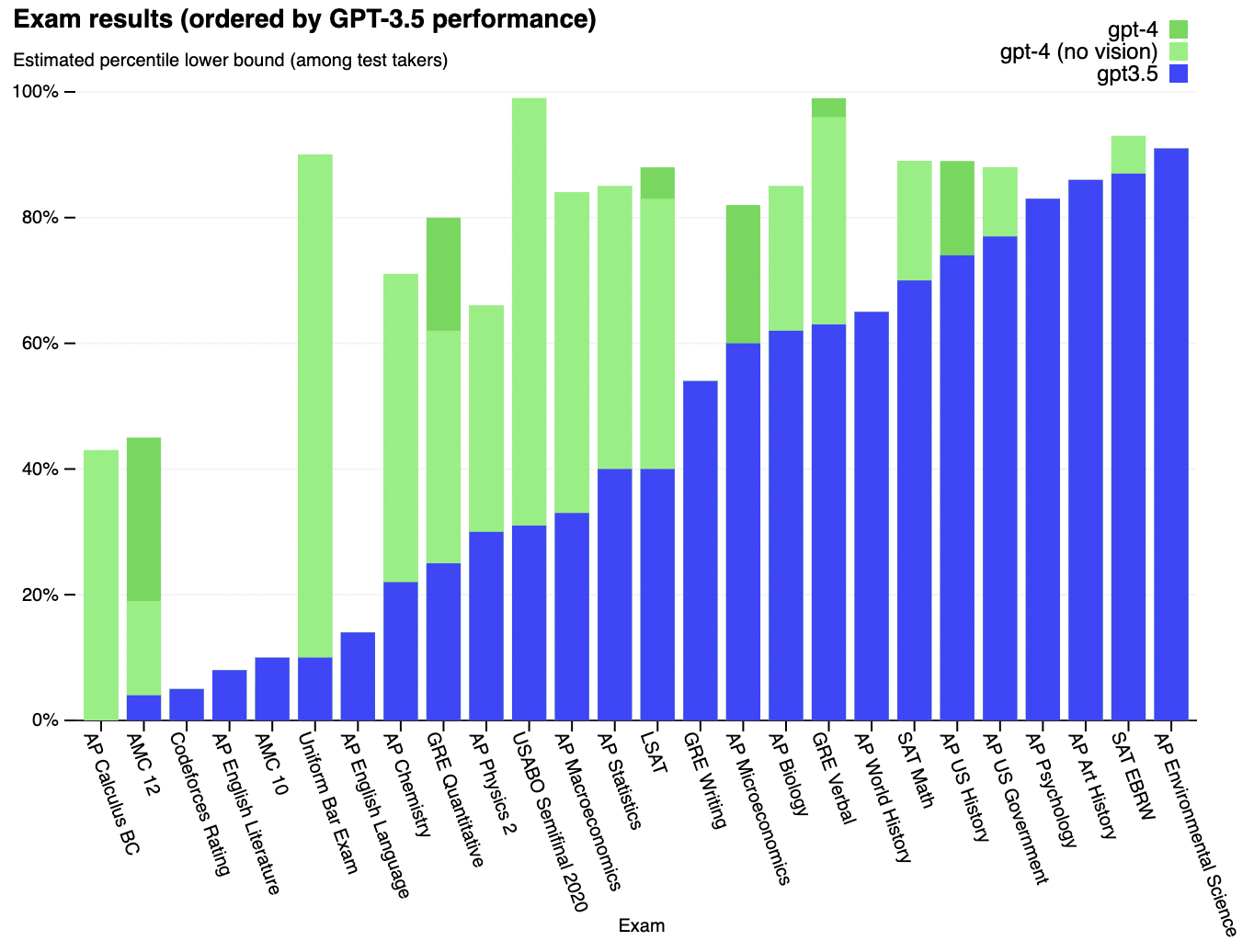
By the appears to be like of it (we haven’t examined it ourselves) and a few preliminary check outcomes, GPT-4 does appear to be a substantial enchancment over its predecessor. GPT-4 can settle for a immediate of textual content and pictures, which—parallel to the text-only setting—lets the person specify any imaginative and prescient or language activity. Particularly, it generates textual content outputs (pure language, code, and so on.) given inputs consisting of interspersed textual content and pictures. Over a spread of domains—together with paperwork with textual content and images, diagrams, or screenshots—GPT-4 displays comparable capabilities because it does on text-only inputs.
Nonetheless, one of many largest considerations highlighted by many, throughout their respective utilization with GPT-3.5 was the chatbot developing with all kinds of loopy, out-of-bounds solutions and eventualities. And whereas OpenAI says that higher “guardrails” have been put throughout in GPT-4, it stays to be seen the way it performs in real-world eventualities, when it receives zillions of inputs from hundreds of thousands of customers additional time.